

Technical Surveillance Countermeasures
SafeGuard provides professional Technical Surveillance Countermeasures (TSCM) and electronic surveillance detection services for corporate, government, legal, and private environments. From comprehensive assessments and recurring technical security programs to sensitive meetings and specific technical concerns, each engagement is tailored to the environment, circumstances, and security requirements of the client—with appropriate methodology, specialized equipment, and Time on Target.
TSCM Assessment Services
Whether an assessment is proactive, recurring, or prompted by a specific concern, SafeGuard combines specialized detection equipment, methodical physical inspection, and technical analysis to evaluate sensitive environments for potential electronic surveillance, technical vulnerabilities, and anomalies requiring further examination.

Comprehensive TSCM Assessments
A comprehensive technical assessment of offices, boardrooms, residences, facilities, and other sensitive environments. SafeGuard combines complementary inspection and detection methods to identify, evaluate, and correlate potential electronic surveillance, technical vulnerabilities, and other anomalies requiring further examination.

Recurring TSCM Programs
For organizations that require continuing technical security assurance, SafeGuard provides recurring TSCM assessments on a scheduled or needs-based basis. Repeated assessments allow the technical environment to be evaluated over time, support the development of historical baselines, and help identify meaningful changes or anomalies that may warrant further examination.

Sensitive Meeting & Live Technical Monitoring
SafeGuard provides technical security support for board meetings, executive sessions, confidential discussions, legal proceedings, and other sensitive events. Engagements may include pre-event TSCM assessment and technical baselining, followed by live monitoring of the RF and wireless environment during the event to identify, correlate, and evaluate meaningful changes or unusual activity as it occurs.

Vehicle & Aircraft Assessments
SafeGuard provides specialized technical security assessments for vehicles and aircraft where privacy, sensitive communications, or potential electronic surveillance are a concern. Assessments combine appropriate RF and wireless analysis, methodical physical and visual inspection, nonlinear junction detection, optical examination, and other applicable technical methods based on the platform and circumstances.

Targeted Technical Audits
When a specific technical concern, unexplained anomaly, suspicious device, or potential surveillance issue has been identified, SafeGuard can conduct a focused technical assessment tailored to the circumstances. Appropriate equipment, inspection methods, and Time on Target are selected based on the concern and environment rather than applying a predetermined approach to every situation.
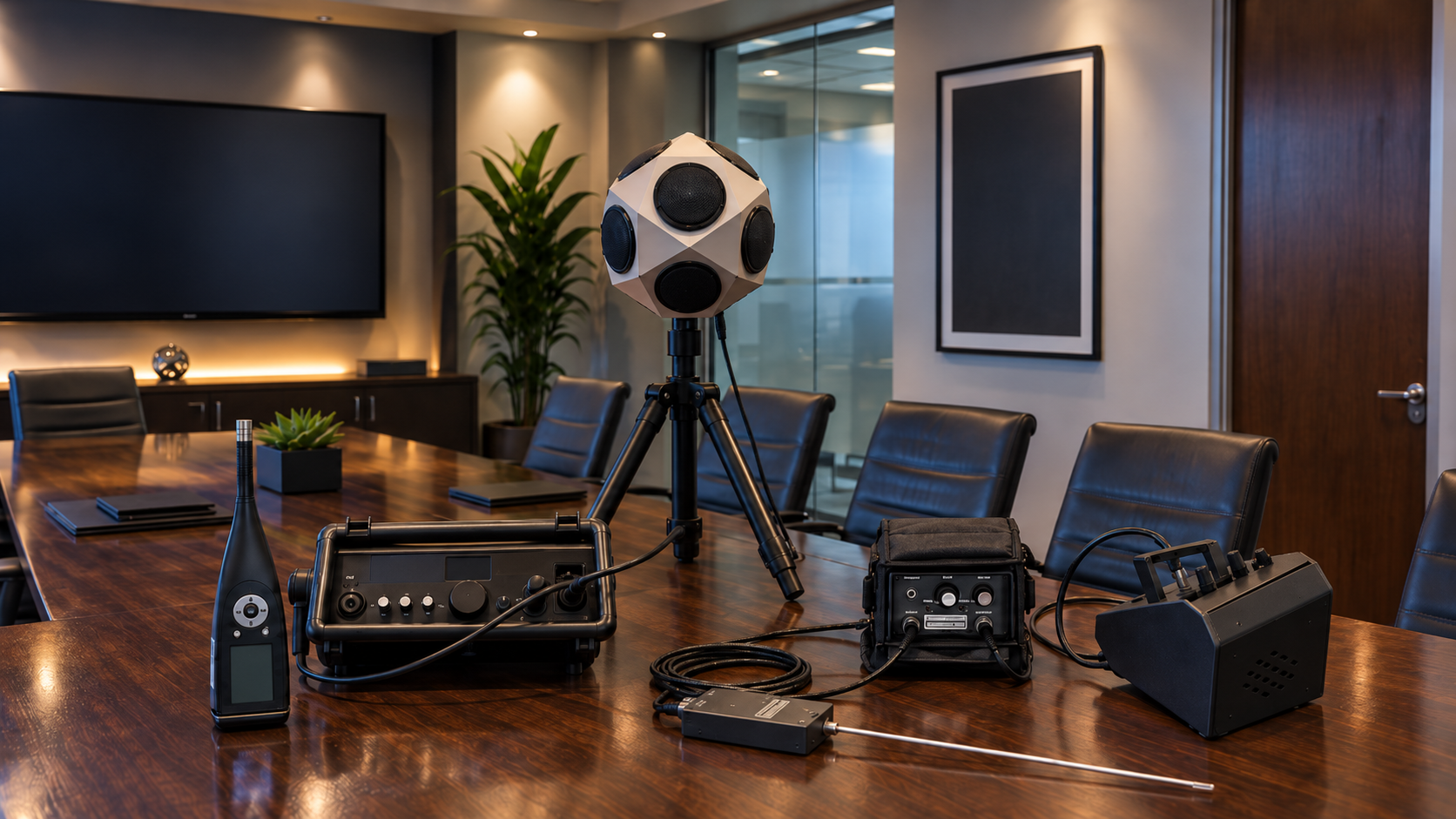
Acoustic Security Analysis
Sensitive environments can remain vulnerable even when no conventional RF threat is identified. SafeGuard can deploy professional acoustic measurement and analysis equipment to evaluate how sound behaves within protected spaces, how it may travel beyond them, and whether acoustic conditions warrant further examination.
Acoustic Security Analysis may include controlled sound-transmission measurements, evaluation of potential acoustic leakage paths, assessment of doors, walls, windows, ducts, and structural penetrations, review of sound-masking performance, and other appropriate acoustic examination methods based on the environment and assessment objective.
For recurring clients, repeatable acoustic measurements can also establish a technical baseline for designated sensitive rooms. Subsequent assessments can be compared against prior results to identify meaningful changes that warrant further investigation.
Key Capabilities: Acoustic Leakage & Sound-Transmission Analysis • Acoustic Baseline Comparison • Sound-Masking Evaluation • Acoustic Anomaly Analysis
What to Expect
Confirm the Scope
Objectives, designated areas, access, and communication preferences.
Assess the Environment
Complementary technical examination and physical inspection.
Investigate Observations
Cross-check meaningful anomalies before reaching conclusions.
Report Clearly
Coverage, methods, findings, limitations, and practical next steps.
When to schedule a TSCM inspection
TSCM assessments may be appropriate before or after sensitive meetings, during periods of organizational change, following unusual or unexplained technical activity, when confidential information may be at risk, or as part of a proactive technical security program. Recurring assessments can also establish a technical baseline for an environment, providing historical context that can help identify and evaluate meaningful changes or anomalies over time.
A specific suspicion is not required to benefit from a professional TSCM assessment.
Why Professional TSCM Matters

Professional TSCM is far more than a quick inspection or reliance on a single detector. SafeGuard conducts layered technical assessments using complementary methods that may include RF spectrum analysis, cellular, Wi-Fi and Bluetooth analysis, nonlinear junction detection, physical and visual inspection, optical examination, wired and conductive-path analysis, portable X-ray when appropriate, and acoustic analysis.
No single instrument tells the whole story. Each method provides a different technical perspective, allowing observations and anomalies to be correlated across multiple layers before conclusions are reached.
Scope and Time on Target are determined by the size, complexity, use, and conditions of the environment—not by a rushed, predetermined checklist. SafeGuard approaches each engagement methodically, documents what was evaluated, and gives meaningful findings the attention required for responsible analysis.
Clear Findings & Practical Next Steps

Every engagement concludes with a confidential report documenting the assessment scope, methods used, areas evaluated, observations, findings, limitations, and recommended next steps. Information is presented clearly for both technical review and executive decision-making—without sensational language or unsupported conclusions.
For recurring clients, this documentation creates a developing technical history of the protected environment. RF, acoustic, and other applicable technical baselines can be compared over time, helping auditors identify and evaluate new devices, meaningful environmental changes, and developing anomalies during future assessments.
Begin with your Environment
FairScope helps develop preliminary planning guidance. An auditor then confirms the appropriate engagement with you.